One quiet decision at a time, fear can carry you further from the life you were meant to live. It has a name, and it isn't the one you've been given.
There is a version of your life that was waiting for you. Not a fixed script, but a direction, one that unfolds when you are living from who you actually are rather than from what you fear.
Most people never notice the moment they left it.
It rarely happens as one dramatic wrong turn. It happens in yeses. The yes you say when every part of you wanted to say no. The job you stay in to prove you are enough. The plans you agree to because disappointing someone feels more dangerous than disappointing yourself. Each one feels small. Forgivable. Necessary, even. But a life is built from thousands of small choices, and when enough of them are made from fear instead of desire, they compound. They carry you further and further from the direction you were meant to travel in, until one day you look up and ask how you ever got here.
I am a CBT psychotherapist and cognitive behavioural coach, and this is the question underneath almost every client who sits across from me. Not "why am I so anxious." Underneath that: "how did my life end up so far from what I wanted it to be."
The yes was never really about the other person
Here is what I have learned after years of this work. The yes you cannot stop saying is never really about the person asking. It is about you.
It is a fear based behaviour, built a long time ago, to protect a much younger version of you from feeling unsafe. Somewhere, a belief took root that said, I am only safe, only acceptable, only loveable, if I do not get this wrong, if I do not let anyone down, if I am endlessly useful. That belief does not stay in childhood. It grows up with you. It shows up as the high achieving professional who cannot delegate, not because they are "type A," but because handing work to someone else risks being seen as not good enough. It shows up as the person who says yes to everything, not because they are naturally giving, but because a no feels like risking rejection. It shows up as perfectionism, which is not high standards. It is what happens when your sense of being okay becomes tied to never getting it wrong.
None of this is a personality trait. It is not something you are stuck with for life. It is a fear response, and fear responses can be understood, worked with, and changed.
We have been treating the symptom as the sentence
Somewhere along the way, we started treating a diagnosis as a destination. A person arrives exhausted, anxious, unable to say no, terrified of getting things wrong, and they leave with a name for it. Anxiety disorder. Depression. For a while, having the name feels like relief. Finally, an explanation.
But a label was never meant to be an ending. It describes what is happening on the surface. It does not explain why, and it was never designed to.
None of this is a rejection of psychiatry, or of the very real, sometimes severe and enduring conditions that people live with, or of medication where it is genuinely needed and properly supervised. Those things save lives.
What I am questioning is our habit of stopping at the label. Of treating "you have anxiety" as a complete explanation rather than a description of what an old, unresolved wound looks like once it surfaces. Of managing symptoms indefinitely instead of asking what those symptoms have been trying to say all along.
I have supported clients who had spent years believing their anxiety, their exhaustion, their compulsive overworking, was simply who they were, a fixed trait to manage rather than a signal to understand. When we found what that anxiety was actually protecting them from, and did the work at the root, the symptoms did not need managing anymore. They eased, because the thing generating them was no longer live.
That is the work. Not managing the smoke. Finding the fire.
The moving finish line
Perfectionism and people pleasing are the two behaviours doing the most damage while looking the most acceptable. Society rewards both. The perfectionist gets praised for their standards. The people pleaser gets praised for being so easy, so selfless, so reliable.
Nobody claps for the exhaustion underneath.
I call it the moving finish line. No matter how much the perfectionist achieves, the line moves again, because the goal was never really the achievement. The goal was to finally feel safe enough, worthy enough, good enough. That feeling cannot be earned through performance, because it was never lost through performance. It was lost somewhere much earlier, and it can only be recovered by going back to where it started.
What is actually at stake
This is why the question in the title is not rhetorical. Every yes said out of fear rather than desire is a small departure from the direction your life was meant to take. One yes does not undo a life. But a decade of them will quietly build a life you do not recognise as your own, filled with achievements that never satisfy and relationships that never quite feel safe, because none of it was ever really chosen. It was managed, performed, endured.
People have a right to understand this about their own mind. They have a right to know that what they have been told is a mental health problem is very often a symptom, a signal, not a permanent verdict on who they are. That difference is not a small reframe. It is the difference between a life spent managing symptoms and a life spent finally walking in the direction it was always meant to go.
The people I work with are not broken. They are not defined by a lifelong condition they must simply learn to live alongside. They are carrying a wound that has been misread as a personality, and once it is finally seen for what it is, it can be worked with.
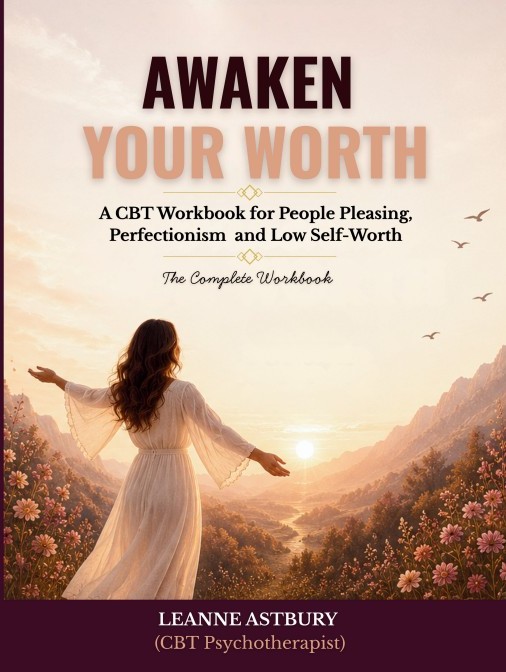
This is the work at the heart of Awaken Your Worth: A CBT Workbook for People Pleasing, Perfectionism, Low Self-Worth and Anxiety. It exists because every person carrying one of these labels deserves to be asked the deeper question before they hand over another decade to managing the symptom.
Not what is wrong with you. What happened to you, and how many yeses has it cost you since.
Get the Workbook on Amazon